My two favorite games of all time are Hollow Knight and Celeste. I’m not going to be able to review Lone Fungus without comparing to these two games. Be warned.
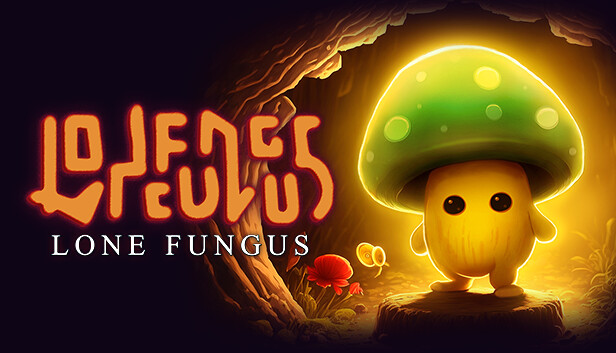
Lone Fungus is not, as I had expected, a Hollow Knight knockoff. (Haiku the Robot is exactly that, by the way, and I recommend it wholeheartedly.) Rather, Lone Fungus mashes together traits from many of my favorite games, and ends up being a Jack of All Trades, Master of None. But is that really better than a master of one?
Lone Fungus can be split into three parts: Combat, exploration, and platforming.
I’ll start with the platforming, because surprisingly, that’s where this game shines. Rather than the stiff, precise platforming of games like Hollow Knight, Metroid, or Castlevania, Lone Fungus opts for more momentum-based movement as in games like Celeste, Mario, and Sonic. This is a real platformer, with challenge rooms that rival anything in Celeste.
While the movement is not on Celeste’s level, and the moves don’t feel as intuitive as some of the platforming greats, I would still put Lone Fungus’s platforming on a pedestal. The challenge rooms especially have that addictive ‘just one more try’ feeling that drags me into another blisteringly fast reflex challenge.
The same can’t be said for the combat. I’d call it serviceable, for sure, but the movement in this game doesn’t lend itself to combat as well as in other Metroidvanias. Little touches, like being able to push the enemy back with a sword strike enough that they don’t run over you, are sadly absent in some areas. The enemy and boss design has its ups and downs as well. In time, I found myself skipping as many enemies as I could while exploring. The boss battles often required complicated platforming movement to dodge, and clever positioning only helped so much.
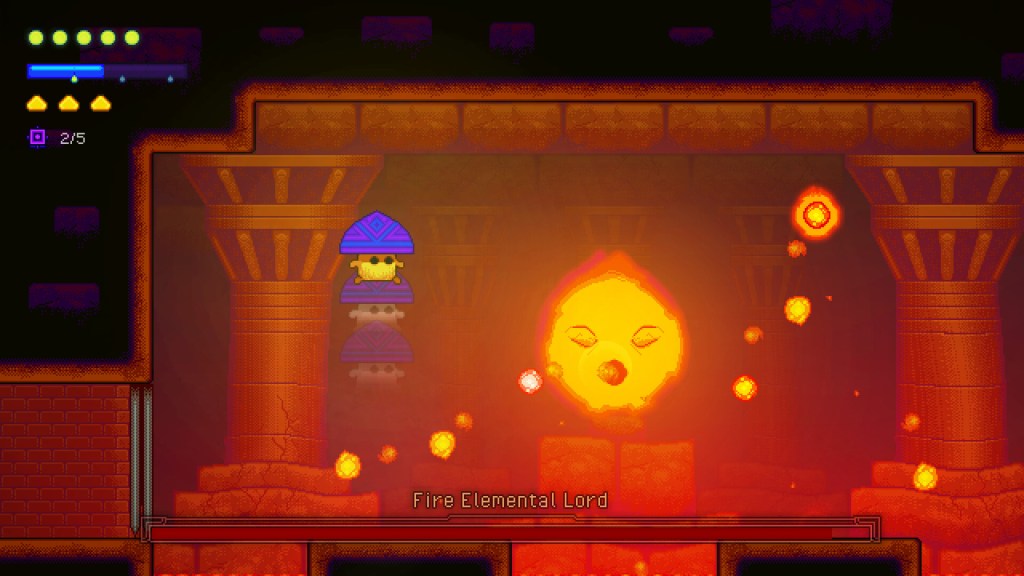
The exploration is another mixed bag. By and large I liked zipping around the levels (when I could avoid combat), and discovering platforming challenges was great fun. But as for the spells, emblems, and power-ups… I’m split on these. Some of them I really like, and some I don’t care for. Having my moveset change constantly made the gameplay less intuitive.
That aside, many of the quality-of-life design choices in this game are extremely solid. Training rooms, portals back to old challenge rooms, automated map markers, as well as notifications and upgrades that have to do with teleporting. I loved the way the game handled its resource management, and the speed at which I was always encountering something new.
The lore ties up this whole mixed bag with a mixed bow. The Lone Fungus itself is irreverent, and the world it interacts with is overblown and cliche at the same time. It wasn’t bad, per se, but never evoked a sense of wonder in me.
Look at all these flaws. Should you play Lone Fungus? If you like Metroidvanias, then probably. It’s a less sound package than Haiku the Robot, but it takes chances and does something new and innovative with many of its choices as well. No part of this game is bad. I compared Lone Fungus to the best I’ve ever played, and the fact that I used those comparisons is praise enough. I binged the heck out of this game until I saw credits, and cared enough about Lone Fungus’s potential to write this long review. Give it a try yourself.
Verdict: 10 hours played, normal ending unlocked, 65.6% complete, 75 deaths.
 Kyle Adams